You turn the key or press the start button before work, the school run or a trip home – and get a slow groan, a rapid clicking sound or nothing at all. The top signs your battery needs a jump start are usually clear once you know what to look for. Acting early can get you moving sooner and may prevent you being stranded in a car park, on your drive or at the roadside.
A jump start is often the right short-term answer, but it does not always fix the reason the battery went flat. Cold weather, short journeys, an ageing battery and charging faults can all produce similar symptoms. The key is knowing whether your vehicle simply needs a boost or needs recovery and a proper check.
Top signs a battery needs a jump start
The engine turns over very slowly
A healthy battery should crank the engine with purpose. If the starter motor sounds sluggish, as though the engine is struggling to wake up, the battery may not have enough charge to start the vehicle. You might get one slow attempt followed by a click, or the engine may turn over for several seconds without firing.
This is particularly common on cold mornings. Low temperatures reduce a battery’s available power, while the engine needs more effort to start. If the car starts normally after a jump and then keeps starting well for the next few days, a one-off low charge is possible. If it happens again, do not ignore it.
You hear repeated clicking when you try to start
Rapid clicking from under the bonnet is one of the clearest signs of a weak battery. The starter solenoid is trying to engage, but there is not enough power to turn the starter motor properly.
One firm click can sometimes point to a starter motor issue instead. Repeated fast clicks, especially alongside dim dashboard lights, are more likely to be battery-related. A jump start may get the engine running, but a recurring clicking problem needs investigation.
Dashboard lights are dim, flickering or absent
Before starting the engine, look at the dashboard and interior light. Weak, flickering or unusually dim lights suggest the battery voltage has dropped. You may also notice the electric windows moving slowly, the central locking working intermittently or the infotainment screen resetting.
Modern cars rely on steady battery power for far more than starting. When voltage is low, warning messages can appear for unrelated systems, from braking to steering assistance. Do not assume every warning means that component has failed. Get the battery and charging system checked first, especially if several warnings appear at once.
The car has been standing for several days
A vehicle that has not been driven for a week or two can lose enough charge to struggle, particularly in winter. Alarm systems, trackers, dash cams and other background electrical systems continue drawing a small amount of power while parked.
Short trips can cause the same problem. Starting a car takes a sizeable burst of power, and a ten-minute journey may not give the alternator enough time to replace it. If most of your driving is local, an occasional longer run can help, but it will not rescue a battery that is worn out.
It starts after a jump, then soon goes flat again
This is the point where a jump start becomes a warning rather than a solution. Once the engine has started, the alternator should recharge the battery while you drive. If the vehicle needs another jump shortly afterwards, the battery may no longer hold charge, the alternator may not be charging correctly, or something may be draining power while parked.
Avoid relying on daily jump starts. It is inconvenient, but more importantly it can leave you stuck at the worst possible time. Arrange a battery and charging-system test as soon as practical.
Symptoms that may not be the battery
A non-starting vehicle is not always a flat battery. If the dashboard lights are bright and normal but the engine will not crank, the fault could be the starter motor, ignition system, key recognition or a wiring issue. If the engine turns over at normal speed but does not fire, fuel, spark or engine-management faults may be involved.
In these cases, forcing repeated start attempts can flatten a good battery and make diagnosis harder. If you are unsure, stop after a couple of sensible attempts. A recovery professional can assess the situation and move the vehicle safely if a jump does not solve it.
What to do when your battery is flat
First, put the vehicle in a safe position. Apply the handbrake, switch off lights, heaters, phone chargers and other electrical items, then try starting it once more. If you are on a live road, in poor visibility or in an unsafe place, focus on getting help rather than lifting the bonnet yourself.
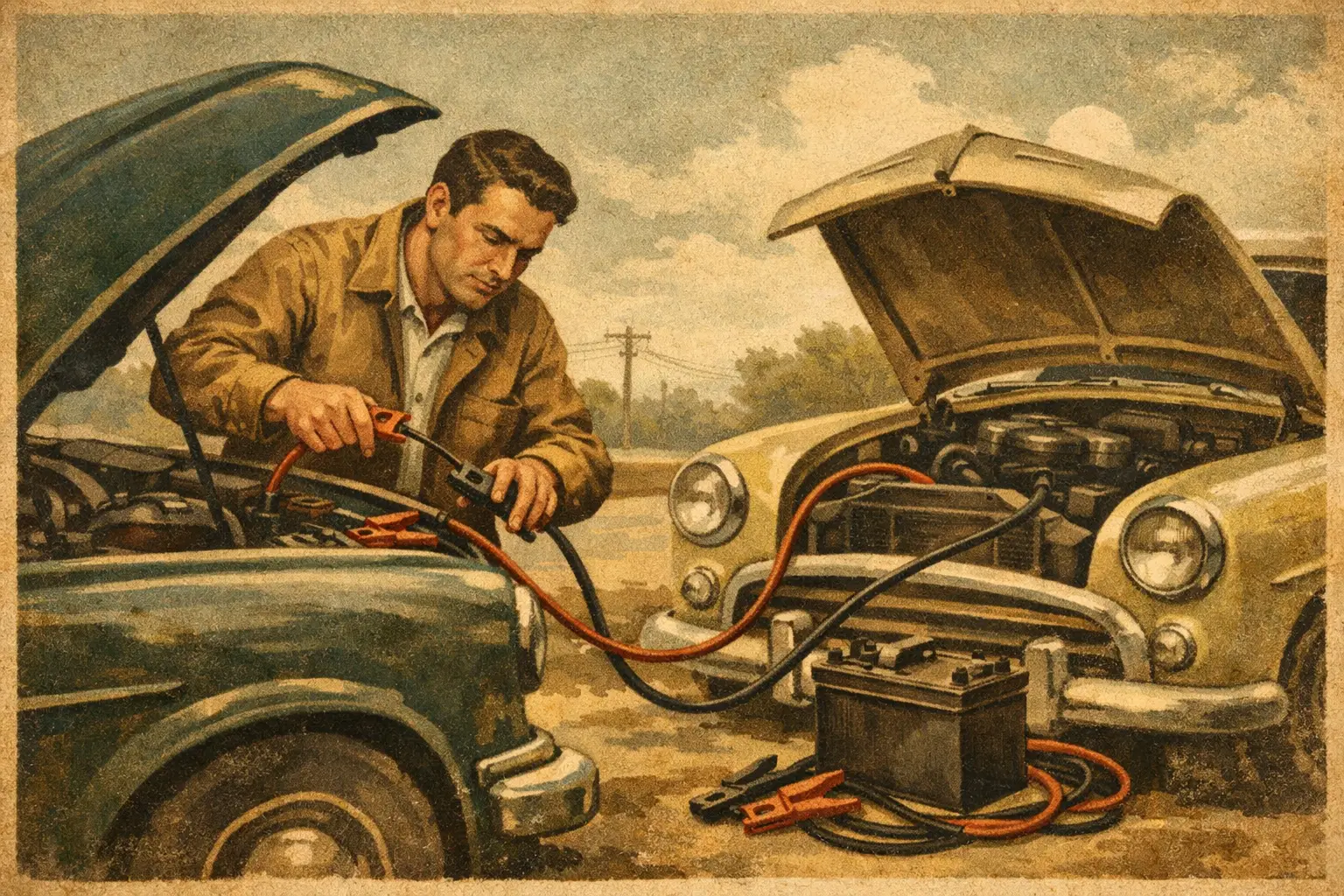
If you have jump leads and another suitable vehicle, follow the vehicle manufacturer’s instructions carefully. Both vehicles should be parked without touching, with engines switched off while connecting the leads. Connect the positive terminals first, then connect the negative lead to a solid metal earth point on the flat vehicle where recommended, rather than directly to the battery negative terminal.
Start the assisting vehicle, allow it to run briefly, then try the flat vehicle. Once it starts, remove the leads in reverse order. Do not let the clamps touch each other, and never attempt a jump if the battery is damaged, leaking, swollen, frozen or giving off a strong smell. Those are safety risks, not a roadside fix.
Not every car should be jumped in the same way. Some hybrids, electric vehicles and newer vehicles with battery-management systems have specific jump points and procedures. Using the wrong connection can cause costly electrical damage. Check the handbook or call for assistance if you have any doubt.
How long should you drive after a jump start?
A steady drive of around 20 to 30 minutes may put some charge back into a healthy battery, but it is not a guaranteed cure. Heavy traffic, heated screens, headlights and short stop-start journeys reduce how much charging takes place. An older battery can appear to recover, then fail again once the engine is switched off.
If you have just needed a jump, avoid turning the engine off until you are somewhere safe and can deal with the cause. If the battery is more than four or five years old, replacement may be the sensible option even if it starts again. Battery life varies with use, weather and vehicle type, so age alone is not a diagnosis, but it is a useful clue.
When to call for a jump start or recovery
Calling for help makes sense when you do not have safe equipment, you are parked somewhere exposed, or the vehicle does not respond to a jump. It is also the safer choice if you are travelling with children, have limited time, or cannot risk being left with a car that fails again at the next stop.
For drivers in Peterborough and nearby areas, Car Recovery Peterborough can provide 24/7 roadside jump-start assistance and recovery where a boost is not enough. Be ready to give your location, vehicle registration, make and model, and a simple description of what happens when you try to start. That helps get the right assistance to you without delay.
A flat battery is often a straightforward problem, but repeated failures are your car asking for attention. Get it checked before the next early start, late finish or wet roadside stop turns a small issue into a bigger disruption.
Leave a Reply