
May 19, 2026
10 Best Ways to Avoid Breakdowns
Learn the best ways to avoid breakdowns with simple checks, smarter servicing, and driving habits that help keep…
Read article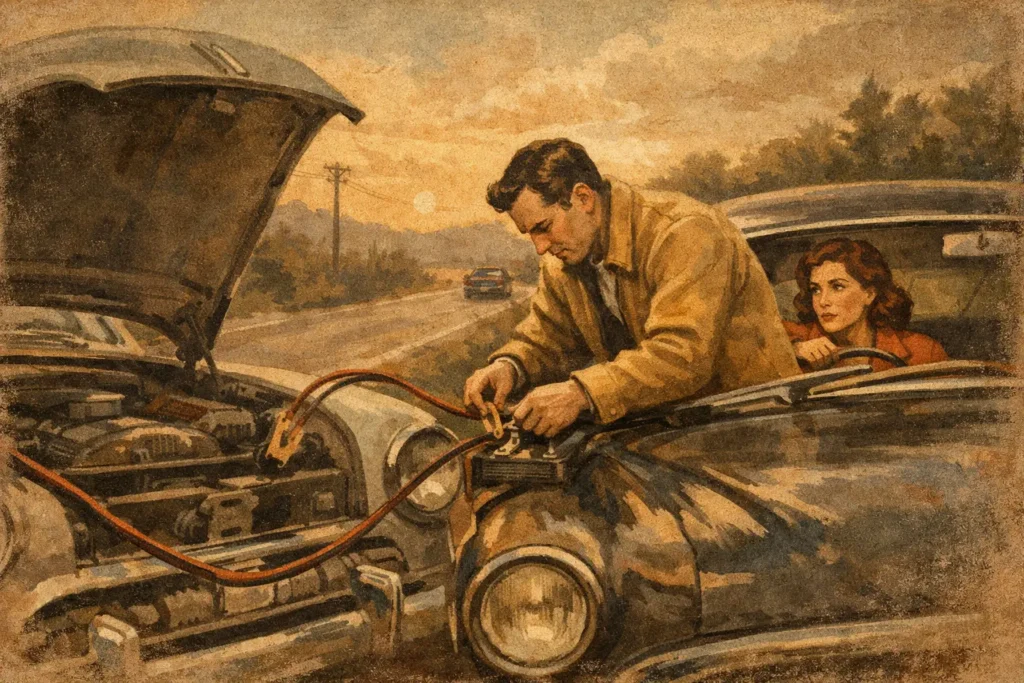
A car that will not start has a habit of choosing the worst possible moment: outside work, on the school run, or when you are already late. Knowing how to get a jump start can get you moving again, but only if the problem is a flat battery and the process is carried out safely. If there is any doubt, getting roadside help is usually quicker and safer than risking damage to either vehicle.
A jump start is designed for a battery that has lost enough charge that it cannot turn the engine over. Common signs include a slow cranking sound, repeated clicking when you turn the key or press the start button, dim dashboard lights, or central locking that seems weak or unresponsive.
It will not fix every non-starting car. If the engine turns over at normal speed but will not fire, the fault may be fuel, ignition, an immobiliser issue or another mechanical problem. A jump start will not help if you have run out of fuel, and it should not be attempted if the battery is leaking, swollen, cracked or smells strongly of rotten eggs. Keep clear and arrange recovery instead.
Modern vehicles can also be less forgiving than older cars. Start-stop systems, battery management sensors and sensitive electronics mean the wrong connection order can cause an expensive problem. Check your vehicle handbook if you have it, particularly if your car has designated jump-start terminals under the bonnet.
You need a second vehicle with a healthy 12-volt battery and a suitable set of jump leads. Both vehicles should be parked close enough for the leads to reach, but they must not touch. Put both in park or neutral, apply the handbrakes and switch off the ignitions, lights, heaters, radios and any other electrical equipment.
Before connecting anything, inspect the battery. Do not proceed if you see damaged casing, fluid around the battery, loose terminals or exposed wiring. Remove rings, watches and other metal jewellery too. A battery can produce explosive gas, and a short circuit can happen very quickly.
Connect the leads in this order:
Make sure the clamps are secure and that no part of the leads can touch a moving belt, fan or pulley. Start the donor vehicle and allow it to idle for a few minutes. Then try to start the car with the flat battery. Avoid holding the key or start button for long periods. If it does not start after a couple of short attempts, stop and reassess rather than repeatedly cranking the engine.
Once the car starts, leave both engines running briefly. Remove the leads in the reverse order: black clamp from the revived car, black clamp from the donor car, red clamp from the donor car, then red clamp from the revived car. Keep the clamps apart throughout.
Starting the engine is only the first part. The battery needs time to recharge, and a short trip around the block often is not enough. If the car is safe to drive, take it for a proper run of at least 20 to 30 minutes, preferably without unnecessary electrical loads such as heated screens, seat heaters or high fan settings.
That said, driving may not solve the underlying issue. A battery nearing the end of its life can accept just enough charge to start once, then fail again at the next stop. A failing alternator may also mean the battery is not charging while you drive. If the battery warning light stays on, lights flicker, or the car cuts out, pull over safely and arrange assistance.
If your vehicle is parked at home, a smart battery charger is often a better option than relying on the alternator. It charges more steadily and can indicate whether the battery is unable to hold charge. This is particularly useful for cars that are used infrequently or only for short journeys.
A portable jump starter can be useful when no second vehicle is available. These compact battery packs connect in much the same way as jump leads, although the instructions supplied with the pack always take priority. Many include reverse-polarity protection, but that is not a reason to rush the connection.
Choose a jump pack rated for your engine size, keep it charged, and store it somewhere dry. Very cold weather reduces battery performance, including the performance of the jump pack itself. If the pack is flat, damaged or unusually hot, do not use it.
A jump pack is convenient, but it does not diagnose the cause of the problem. If you need it more than once, your car needs checking. Repeated boosts can leave you stranded somewhere less convenient than your drive.
There is no prize for solving every breakdown yourself. Call for help if you are on a busy road, in a poorly lit place, without safe space to work, or unsure where the battery or earth point is located. It also makes sense to call if the battery is under a seat, in the boot, or difficult to access.
Professional assistance is the sensible choice when the vehicle has warning lights, electrical faults, damaged battery terminals, or a history of starting problems. The operator can assess whether a boost is appropriate, start the vehicle safely where possible and help you decide whether you can continue your journey or need recovery.
For drivers in Peterborough and surrounding postcodes, Car Recovery Peterborough provides 24/7 jump-start assistance when a flat battery has stopped your plans. Clear details help speed things up: your exact location, vehicle make and model, whether the dashboard lights come on, and whether the car is in a safe place.
Leaving headlights, interior lights or a phone charger plugged in can drain a battery overnight, but not every flat battery is caused by something obvious. Cold mornings put extra strain on an ageing battery. Short, frequent journeys can use more power starting the car than the alternator has time to replace. Corroded terminals, a faulty alternator, a parasitic electrical drain and a battery that is simply old can all be responsible.
Most conventional car batteries last around three to five years, although usage, weather and vehicle type make a difference. If yours is approaching that age and has begun to struggle, a battery test is worth arranging before it fails completely.
Never connect red to black, use damaged leads or allow the clamps to touch while connected. Do not try to jump-start a frozen battery, and do not use a 24-volt commercial vehicle to boost a standard 12-volt car. Avoid revving the donor vehicle hard in an attempt to force more charge through the leads. Steady idle is enough and puts less strain on both vehicles.
Most importantly, do not ignore a battery that repeatedly goes flat. A jump start is a useful short-term answer, not a permanent repair. Get the battery and charging system checked while the car is running, rather than waiting for the next no-start to catch you out.
Need recovery right now?
WhatsApp Us
Learn the best ways to avoid breakdowns with simple checks, smarter servicing, and driving habits that help keep…
Read article
Need to know who collects scrap cars quickly? Find out what to look for, how fast collection works,…
Read article
Need car recovery in Peterborough? Find out what to expect, how fast help can arrive, and which recovery…
Read article