
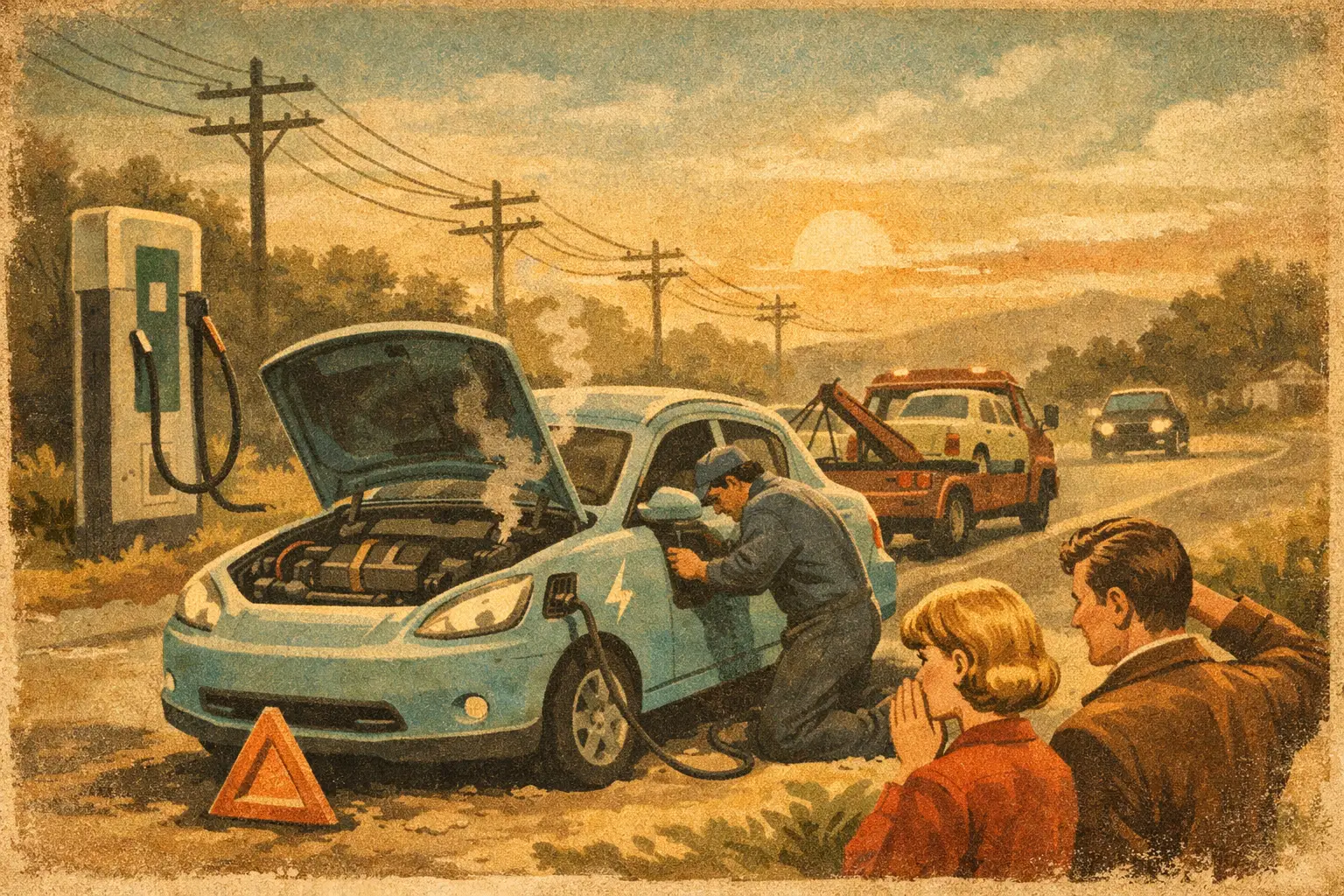
A flat 12V battery can stop an electric car just as completely as a failed starter battery in a petrol model, and that catches plenty of drivers off guard. When people talk about electric car breakdown trends, the big story is not that EVs never fail. It is that they fail differently, and those differences matter when you need fast roadside help.
For drivers, the shift is practical rather than theoretical. You still want the same thing when a car will not move – quick diagnosis, safe recovery and a clear answer on what happens next. The difference is that electric cars tend to have fewer moving parts in the drivetrain, but they introduce new failure points around charging, software and battery management.
What electric car breakdown trends are really showing
The broad pattern is fairly clear. Electric cars usually avoid some of the common faults seen in older petrol and diesel vehicles, such as clutch failure, exhaust problems and many engine-related breakdowns. At the same time, they still suffer from tyres, suspension issues, damaged wheels, 12V battery failure and driver-related callouts such as locking problems or running into charging trouble.
That means EV reliability can look strong in one report and less impressive in another, depending on what is being counted. If a study focuses on major mechanical faults, electric cars often come out well. If it counts every roadside assistance call, including punctures, charging issues and software-related immobilisation, the picture gets more mixed.
This is where a lot of confusion starts. Fewer engine parts does not mean zero breakdown risk. It means the risk profile changes.
The biggest causes behind electric car breakdown trends
12V battery failures are still a major problem
One of the least glamorous parts of an electric car is still one of the most common causes of breakdown. Most EVs rely on a standard 12V battery to power control systems, locks, lights and the electronics needed to start the car’s main systems. If that battery goes flat, the vehicle may not start at all.
Drivers often assume that a fully charged traction battery means the whole car is fine. That is not always the case. You can have plenty of range left and still be stranded because the smaller battery has failed. This is especially common in colder weather, after long periods parked up, or where the battery is ageing.
Tyres wear quickly on many EVs
Electric cars are often heavier than equivalent petrol cars, and they deliver torque instantly. That combination can be hard on tyres. As a result, punctures, sidewall damage and premature tyre wear feature heavily in electric car breakdown trends.
That is not a fault with the motor itself, but it does affect real-world roadside callouts. Some EVs also come without a spare wheel, which turns a simple puncture into a recovery job if the damage is too severe for a temporary repair.
Charging issues are more common than many drivers expect
Not every charging problem is a breakdown in the strict mechanical sense, but if the car cannot charge and does not have enough range to continue, the result is the same – it is immobilised. Faulty charge points, damaged cables, connector issues and onboard charging faults can all leave a driver stuck.
Sometimes the problem is the public charger rather than the vehicle. Sometimes it is a software handshake issue between the car and the charging point. Either way, it can be difficult to sort at the roadside without proper checks.
Software faults can immobilise the vehicle
Modern EVs rely heavily on software to manage charging, battery temperature, power delivery and safety systems. Most of the time that works well. When it does not, the car may enter a reduced-power mode or refuse to drive.
Software faults are awkward because they are not always visible in a simple way. A driver may see a warning message, but the root cause can range from a sensor error to a communications fault between control units. Some issues clear after a restart. Others need dealer-level diagnostics. For roadside recovery, the key question is simple: can the vehicle move safely or not?
Running out of charge still happens
Range anxiety gets mocked sometimes, but depleted batteries remain part of the real-world picture. In fairness, this is not always because the driver was careless. Cold weather, motorway speeds, diversions, charger queues and inaccurate assumptions about available charging can all tighten the margin quickly.
In urban driving, EVs often perform predictably. On longer routes or in poor conditions, range can drop faster than expected. That is why route planning matters more in an EV than in many conventional cars.
How EV breakdowns differ from petrol and diesel callouts
The main difference is not drama. It is process. With a petrol or diesel car, a roadside technician may try a jump start, inspect obvious mechanical faults or carry out minor fixes before deciding on transport. With an electric car, the first priority is safe handling and proper assessment.
Not every immobilised EV can be towed in the same way as a conventional car. Some need full lift recovery rather than being pulled with wheels on the ground, especially if the manufacturer’s guidance says so. Get that wrong and you risk drivetrain damage.
There is also the issue of access. If the car has lost all power, opening it, releasing the parking brake or putting it into transport mode may be less straightforward than drivers expect. That is why specialist awareness matters, even when the fault itself is something simple.
What these trends mean for everyday drivers
The practical takeaway is straightforward. Electric cars are not unreliable by default, but they reward a different kind of preparation. If you own one, it makes sense to pay more attention to tyre condition, charging habits, warning messages and the health of the 12V battery.
It also helps to know what your manufacturer says about breakdown recovery. Some EVs have very specific instructions on towing, lifting and transport. In a stressful moment, having that information handy can save time.
For local drivers around Peterborough, this matters most when a car stops at an awkward time – before work, on the school run or late at night when options feel limited. Fast recovery is still the priority, but with EVs the method matters as much as the response time.
Are electric cars breaking down more often?
That depends on what kind of failure you mean. If you are talking about traditional mechanical breakdowns linked to engines and gearboxes, EVs often have an advantage. If you are talking about all roadside incidents that stop a journey, the gap narrows.
Newer electric cars can also look better on paper simply because many of them are younger vehicles. As the fleet ages, breakdown patterns may shift again. Battery degradation, charging port wear, corrosion, suspension wear from vehicle weight and electronic faults may become more prominent over time.
So the honest answer is that electric car breakdown trends are still developing. The data is useful, but it needs context. Vehicle age, usage pattern, weather, charging access and maintenance all affect the result.
How to reduce the risk of an EV roadside breakdown
A few habits make a real difference. Keep the 12V battery checked, especially before winter. Do not ignore tyre wear just because the car feels smooth and quiet. Avoid regularly running the main battery very low if you can help it. Make sure your charging cable and port stay clean and undamaged, and pay attention to software updates if your vehicle depends on them for battery and charging management.
It is also worth thinking ahead about recovery rather than waiting for a problem. If your car becomes immobilised, you want a service that can respond quickly, handle non-running vehicles properly and arrange transport without fuss. That is exactly the kind of situation where a no-nonsense local operator such as Car Recovery Peterborough fits best.
The road ahead for electric car breakdown trends
The next few years will probably bring fewer surprises and more pattern recognition. Recovery operators will get more familiar with EV-specific procedures, workshops will become better equipped for diagnosis, and drivers will understand their cars better. At the same time, more older EVs on the road will reveal which components hold up well and which do not.
That is the real point behind following electric car breakdown trends. It is not about proving that EVs are perfect or flawed. It is about knowing what actually goes wrong, so drivers can prepare properly and get the right help fast when something does stop them. If your car will not move, labels matter less than response time, safe handling and a clear plan to get you going again.
Leave a Reply