
May 14, 2026
Accident Recovery After Collision: What to Do
Need accident recovery after collision? Learn what to do at the scene, when to call recovery, and how…
Read article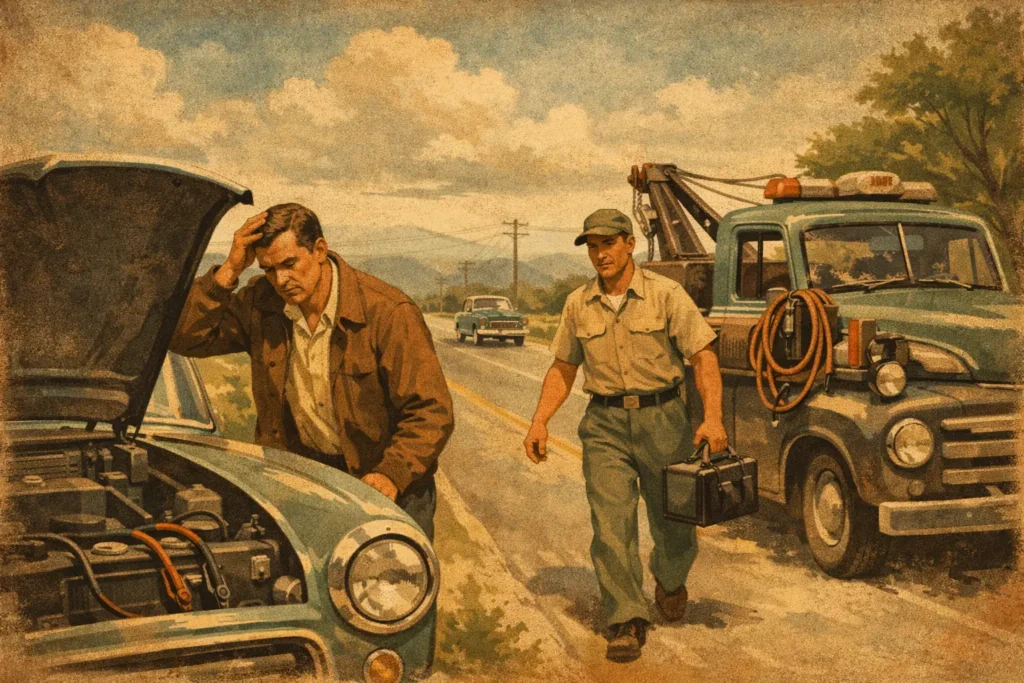
Your car will not start outside work, on the school run or in a supermarket car park. The dash lights may be weak, the starter may click once, or nothing may happen at all. A flat battery callout example helps you give the right details first time, so the recovery operator can assess the job and get help moving without unnecessary back-and-forth.
A flat battery is often straightforward, but it is not always just a case of attaching jump leads. The age of the battery, the condition of the vehicle, where it is parked and whether it starts after a boost all affect what should happen next.
When you request assistance, keep the message simple and practical. The operator mainly needs to know where you are, what vehicle you have and what the car is doing when you try to start it.
> “My 2016 Ford Focus will not start outside PE3. The dashboard lights come on but the engine only clicks. It is parked safely on my driveway with access at the front. I need a jump start and may need recovery if it does not restart.”
That is enough to begin with. If you know the registration, provide it. It can help confirm the vehicle details. Mention whether the car is manual or automatic, especially if recovery may be needed, and say if it is in a multistorey car park, underground bay, narrow street or behind a locked gate.
You should also flag up anything unusual. Perhaps the battery warning light came on while driving, the battery has gone flat more than once this week, or the car has been standing for several months. These details do not diagnose the fault on their own, but they help set realistic expectations.
Once a location and vehicle have been confirmed, the first priority is safe access. If you are on a live road, move yourself and passengers to a safe place if possible. Put on hazard lights where appropriate, but do not stand in traffic or attempt a roadside jump start yourself in an unsafe position.
On arrival, the recovery operator will normally check the obvious signs of a discharged battery. Dim interior lights, repeated clicking from the starter and a slow crank are common clues. They will also consider whether the vehicle can be safely jump started at its current location.
If a boost is suitable, the vehicle may be connected to a jump pack or suitable starting equipment. Modern vehicles can be sensitive, so it is better not to guess at connection points or use damaged leads. Once the engine starts, it should be allowed to run and the charging system may be checked where practical.
The key question is not only whether the engine starts. It is whether it stays running and is likely to restart after being switched off. A battery that has simply been drained by an interior light left on may recover after charging and a proper journey. A battery that has failed internally, or a vehicle with an alternator problem, may stop again very quickly.
Imagine you finish a late shift in Peterborough and find that your car will not start in the staff car park. The central locking works slowly, the dashboard flickers and the engine will not turn over. You have no warning lights showing from before the journey, but you remember leaving a mobile phone charger plugged in overnight.
You contact a local recovery service with your exact car park location, vehicle registration and the symptoms. The car is accessible, the bonnet opens normally and there is no immediate safety issue. A jump start gets the engine running, and it continues to run without obvious warning lights.
In that situation, you may be advised to drive directly home or to a garage, avoiding unnecessary stops. If the battery is older, or the vehicle has been difficult to start recently, it is sensible to arrange a battery and charging-system check soon. The jump start solves the immediate problem, but it does not guarantee the cause has disappeared.
Now change one detail. The engine starts with a boost but cuts out shortly afterwards, or a battery warning light stays on. That points towards a different issue, potentially a charging fault. Driving on could leave you stranded again or cause further problems. Recovery to a safe destination is often the more sensible option.
A flat battery callout can turn into a recovery job, and that is not a failure. It is the correct outcome when the vehicle cannot be made safe or reliable enough to drive.
A jump start may not be appropriate if there is visible battery damage, a strong rotten-egg smell, leaking fluid, smoke, damaged wiring or signs of an electrical fault. Do not touch a swollen, cracked or leaking battery. Keep clear of the vehicle if you suspect an electrical fire risk and call emergency services where necessary.
Recovery may also be needed if the car is an electric or hybrid vehicle with an issue beyond the low-voltage starter battery. These vehicles still use a 12-volt battery, but their systems need careful handling. Tell the operator what type of vehicle it is before they arrive.
It also depends on the car’s position. A vehicle stuck in a tight bay, with locked wheels, an electronic handbrake fault or no safe access may require different equipment and a planned collection rather than a quick roadside boost.
Turn off everything that is drawing power, including lights, heated screens, the radio and mobile phone chargers. If the vehicle is safe and secure, avoid repeatedly trying the ignition. Every failed attempt can drain the remaining charge further.
Have your location ready. A postcode is useful, but a precise description is better in large car parks, on country lanes or near roundabouts. Give the road name, the nearest landmark and your vehicle colour if visibility is poor. Keep your mobile phone charged if possible and stay somewhere safe, warm and visible.
If you are at home, make sure the vehicle is not blocked in and that the recovery operator can reach the bonnet. If it is on private land or in a controlled car park, check whether there are height barriers, gates or access restrictions. A few clear details can prevent delays.
Some flat batteries are one-off events. A car left unused during a holiday, a door not fully shut or an interior light left on can be enough to flatten a battery. Short trips in cold weather can also leave the battery undercharged, particularly if you use heaters, lights and demisters regularly.
Repeated flat batteries need investigation. The battery may be old, the alternator may not be charging properly, or an electrical component may be draining power while the car is parked. Replacing the battery without checking the underlying cause can be a costly short-term fix.
If your car starts after assistance, use the time wisely. Book a battery test, especially if it is more than a few years old or has struggled through recent cold mornings. Keep terminals clean, make sure the battery is secure and use the vehicle regularly enough to maintain charge. If you only make short local journeys, an occasional longer drive may help, although it will not repair a failing battery.
When your vehicle will not start, clear information and a safe plan matter more than trying random fixes at the kerbside. For urgent help in Peterborough and nearby areas, Car Recovery Peterborough can assess whether a jump start or vehicle recovery is the practical next step. Send the location, vehicle details and symptoms, then let the right equipment do the work.
Need recovery right now?
WhatsApp Us
Need accident recovery after collision? Learn what to do at the scene, when to call recovery, and how…
Read article
Best car recovery response times depend on location, traffic and vehicle type. Learn what is realistic, what causes…
Read article
Need car recovery for steering lock problems? Learn what causes locked steering, what to do safely, and when…
Read article