Your car is sitting on the drive, the dash barely lights up, and now the school run, commute or job is suddenly on hold. If you are looking for a flat battery home visit example, what you usually want is simple – what actually happens when someone comes out, how quickly it can be sorted, and whether the car will start without further trouble.
A home battery callout is usually one of the more straightforward breakdown jobs, but not every flat battery is just a flat battery. Sometimes the battery has drained because a light was left on. Sometimes it is old and finished. Sometimes there is another fault hiding underneath, such as a charging issue or a poor connection. That is why a proper visit is not just about clipping on leads and hoping for the best.
A real flat battery home visit example
Imagine this common situation. A driver heads out at 7:10 in the morning, turns the key, and gets a slow crank followed by clicking. The headlights are weak and the car will not start. It was fine two days ago, but the weather has turned colder and the vehicle has only been doing short trips.
They call for help from home. The operator asks a few quick questions – the make and model, the postcode, whether the engine turns at all, and whether there are warning lights or any signs of damage. This matters because a dead battery sounds different from a starter motor fault, an immobiliser issue, or a car that has run out of fuel.
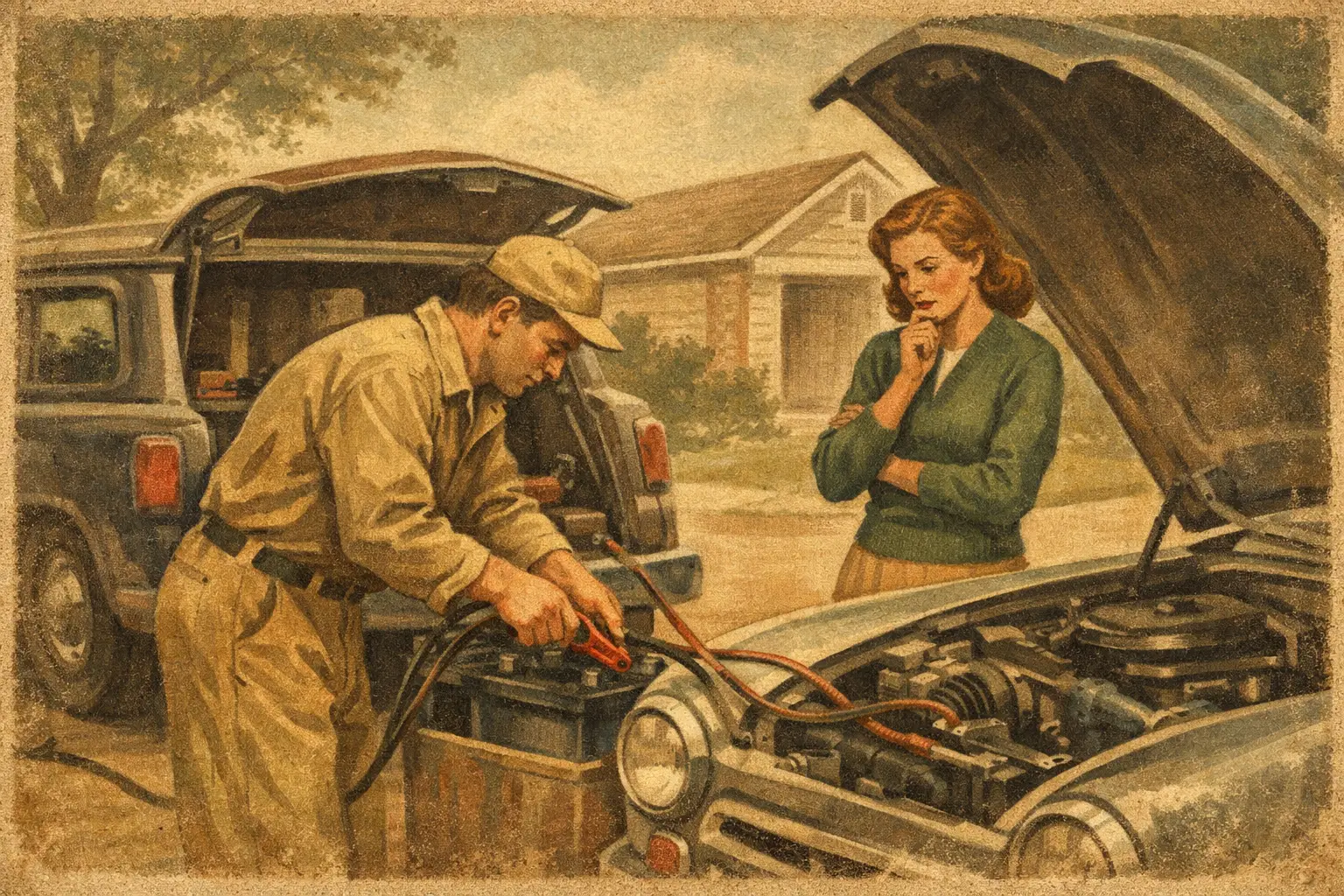
Once the recovery operator arrives, the first step is usually a quick assessment rather than an instant jump start. The bonnet is opened, the battery terminals are checked for looseness or corrosion, and the voltage may be tested. If the battery is simply low, a jump pack can often get the engine going within minutes.
After the engine starts, the job is not finished. A decent operator will usually check whether the alternator appears to be charging and whether the battery holds up once the jump pack is removed. If the car cuts out again straight away, the problem may be more than a temporary drain. If it idles properly and the charging system looks healthy, you may be advised to drive the car for a sensible period or replace the battery soon if it is clearly weak.
That is the practical version of a flat battery home visit example. It is fast when the issue is only low charge, but it can turn into battery replacement advice or recovery if the battery is beyond saving or another electrical fault is present.
What usually happens during the visit
Most drivers picture a jump start and little else. In reality, a proper home visit is about getting the car going safely and avoiding a repeat call an hour later.
The operator normally begins by confirming the symptoms. Clicking, dim dashboard lights and no crank often point to a battery problem. No response at all could still be battery-related, but it might also be a bad connection, blown fuse, failed starter or immobiliser issue.
Next comes access and safety. The vehicle needs to be in a stable position with enough room to work around the front or side of the engine bay. If the car is parked tightly in a garage or nose-first against a wall, that can slow things down. Modern vehicles can also have battery locations that are less obvious than older cars, so the process is not always as quick as people expect.
Then the battery and connections are checked. Loose clamps, heavy corrosion, or obvious battery failure can change the plan. If the terminals are poor, a jump start may work briefly but not solve the problem. In those cases, the issue needs identifying before the vehicle is relied on.
If a jump start is suitable, the operator uses professional equipment rather than another car and a cheap set of leads. That reduces the risk of voltage spikes, connection mistakes and wasted time. Once running, the car is observed to make sure it keeps going on its own.
When a jump start is enough and when it is not
This is where expectations need to be realistic. A jump start is often enough if the battery has been drained by something obvious, such as an interior light left on, a car standing unused, or repeated short journeys in cold weather.
It is less likely to be a full fix if the battery is old, has a dead cell, or has been going weak for weeks. In that case, the home visit gets you moving, but the battery may fail again the same day or the next morning. That is not poor service – it is the nature of a battery that has reached the end of its life.
There is also the alternator question. If the charging system is not doing its job, the battery may have gone flat for a reason that will keep coming back. A car that starts with assistance but shows signs of poor charging may need workshop attention rather than repeated callouts.
Some vehicles should be handled with extra care, especially newer models with sensitive electronics or vehicles that have been standing a long time. A quick boost is not always the right answer. Sometimes the better option is recovery to a garage or home address where the battery can be replaced properly.
How long a home battery callout takes
In a straightforward case, the on-site part can be very quick. Many flat battery visits are assessed and sorted within 15 to 30 minutes once the operator arrives. The bigger variable is travel time.
Delays usually happen for practical reasons. The vehicle may be blocked in, parked awkwardly, fitted with a concealed battery, or suffering from a fault that only looks like a flat battery at first. Poor weather can also make a simple morning callout busier than expected because many other drivers discover the same problem at once.
If you are in Peterborough or nearby, local coverage matters because the difference between a firm based around the area and one travelling in from further away can be the difference between getting to work and losing half the morning.
What information helps you get faster help
A good call starts with useful detail. You do not need to diagnose the car, but a few clear facts save time. Saying “it clicks but will not start” is more helpful than just saying “it is broken”. Mention if the lights are dim, if the car has been unused, or if the battery is old.
It also helps to tell the operator where the car is parked and whether access is tight. A car on a flat drive is one thing. A vehicle boxed in, on a busy road, or in an underground car park is another. If there is a chance the problem is not just the battery, say so early.
Costs and what affects the price
People often search for an example because they want a rough idea of cost as much as process. The price of a flat battery home visit can vary based on time of day, location, vehicle type and whether the job ends with a successful jump start or needs further recovery.
An out-of-hours call at night is not the same as a routine daytime visit. A straightforward jump start on a standard car is not the same as dealing with a van, a difficult access point or a vehicle that cannot be made mobile. The best approach is a clear quote upfront so you know whether you are paying for a simple battery assist or a larger recovery job if the car still will not run.
Why home visits are worth it for a flat battery
The obvious reason is convenience. You do not need another driver, another car, or the guesswork of using old jump leads from the boot. More importantly, you get someone who sees these faults every day and can usually tell within minutes whether the battery is the whole problem.
That matters because a rushed DIY jump can create more hassle than it solves. Incorrect connections, unsuitable equipment or repeated failed attempts can waste time and add stress. A proper callout keeps things simple – assess the fault, start the vehicle if possible, and advise honestly if the battery needs replacing or the car needs recovering.
For drivers dealing with work, school runs or appointments, that direct approach is usually what matters most. Not a long explanation, just a fast answer and a practical next step.
If your car will not start at home, the best flat battery home visit example is usually the one that ends with clear information. Either the car is safely running again, or you know exactly why it is not and what needs to happen next. That is the kind of help that saves time, not just the kind that turns up.
Leave a Reply