
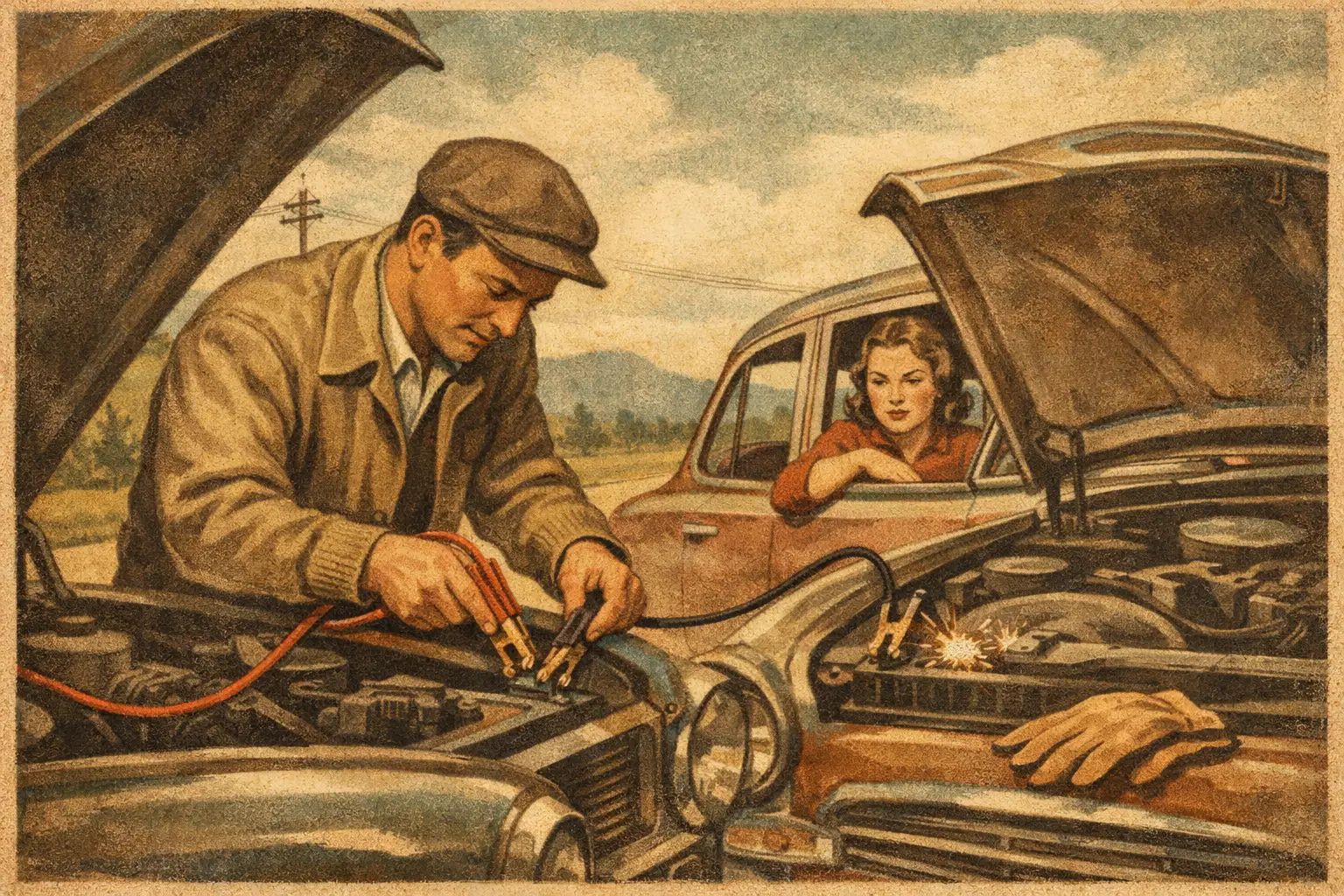
A flat battery usually picks the worst moment. You turn the key, hear a click or nothing at all, and suddenly a simple trip turns into a delay. Knowing how to jump start safely can get you moving again, but only if you do it properly. Get the order wrong, ignore a damaged battery, or use poor leads, and you can create a bigger problem than the one you started with.
When a jump start is the right fix
A jump start helps when the battery has lost enough charge that the engine will not crank, but the rest of the car is broadly fine. That often happens after leaving lights on, not using the car for a while, or during cold weather when batteries are under more strain.
It is not always the answer. If the battery case is cracked, leaking, swollen, or giving off a strong smell, stop there. The same applies if the car has obvious electrical faults, damaged wiring, or warning signs of a more serious issue. In those cases, trying to force a start is not worth the risk.
There is also a difference between an older petrol or diesel car and a newer vehicle packed with electronics. Many modern cars can still be jump started, but they can be less forgiving if the process is done badly. If you are not sure what your manufacturer recommends, take a minute to check the handbook before connecting anything.
How to jump start safely step by step
Start by making sure you have the right kit. You need a set of decent jump leads and a donor vehicle with a battery of the same voltage, which for most cars is 12 volts. Park the vehicles close enough for the leads to reach, but do not let them touch.
Both engines should be switched off before you connect anything. Put both cars in neutral or park, apply the handbrakes, and turn off headlights, heaters, radios, and charging cables. This reduces electrical load and helps avoid voltage spikes.
Now connect the leads in the correct order.
First, attach the red positive lead to the positive terminal on the flat battery. Then connect the other end of the red lead to the positive terminal on the donor battery. After that, connect the black negative lead to the negative terminal on the donor battery.
The final connection matters most. Instead of putting the last black clamp straight onto the negative terminal of the flat battery, attach it to a solid, unpainted metal point on the engine block or chassis of the broken-down car, away from the battery if possible. This gives a safer earth point and reduces the chance of sparks near the battery.
Once the leads are on securely, start the donor car and let it run for a few minutes. Do not rev it hard. A steady idle is usually enough. Then try to start the car with the flat battery. If it starts, let it run.
If it does not start after a couple of attempts, do not keep cranking it over and over. That can overheat components, flatten the donor battery, and point to a fault that is not battery-related. At that stage, it is usually better to stop and get proper roadside assistance.
Removing the leads safely
When the car starts, leave both vehicles as they are for a short moment so the flat battery gets a little charge. Then remove the leads in reverse order.
Take off the black lead from the earth point on the started car first. Next remove the black lead from the donor battery. Then remove the red lead from the donor battery, and finally the red lead from the restarted car.
Be careful that the clamps do not touch each other or any metal surface while still connected at the other end. Once everything is clear, keep the restarted car running.
What to do after the engine starts
A successful jump start does not always mean the problem is solved. It means the car has started. That is not the same thing.
If the battery went flat because of a one-off mistake, such as an interior light being left on, a decent drive may recharge it enough to be fine. A short ten-minute run around town often will not do much. A longer drive is better.
If the battery goes flat again soon after, the battery may be old, the alternator may not be charging properly, or there may be a drain somewhere in the system. That is why repeat jump starts are a warning sign, not a routine fix.
Common mistakes that cause trouble
The biggest mistake is connecting the leads in the wrong order or to the wrong terminals. Positive to positive is essential. Mixing up the clamps can damage electrical systems in seconds.
Another common problem is using cheap or damaged jump leads. Thin, poor-quality leads may not carry enough current, and loose clamps can make the process unreliable. If the leads get hot very quickly, stop.
People also rush to jump start cars with clearly damaged batteries. If the battery is cracked, leaking acid, or looks swollen, do not touch it with leads. That is a recovery job, not a DIY one.
Then there is the issue of assuming every non-start is a flat battery. If you hear no crank and the dashboard is dark, yes, the battery is a likely suspect. But if the engine turns over normally and still will not fire, the fault may be fuel, ignition, immobiliser-related, or something else entirely.
How to jump start safely in bad weather or at the roadside
Weather changes the risk. In rain, low light, or freezing conditions, it is harder to see what you are doing and easier to make mistakes. If you are on a roadside rather than a driveway, safety around traffic matters just as much as safety around the battery.
If the vehicle is in a dangerous position, do not focus on getting it started first. Make the scene safe. Use hazard lights if they still work, move passengers to a safe place, and avoid standing where passing traffic can clip you. If the car is on a busy road, a narrow street, or somewhere with poor visibility, calling for recovery is often the smarter option.
For drivers in and around Peterborough, especially on early starts, school runs, or late-night returns, that decision usually comes down to speed and risk. If you can sort it safely, fine. If not, getting help quickly is the practical choice.
Cars that may need extra caution
Some vehicles should make you pause before attaching leads. Hybrid and electric vehicles are one example, because they have different systems and procedures. Many newer cars also have designated jump start points rather than simple access at the battery terminals.
Large vans, prestige vehicles, and cars with stop-start systems can also be more sensitive. That does not mean they cannot be jump started. It means guessing is a bad plan. If the handbook gives a method, follow it. If it does not feel clear, leave it alone.
When it is better to call for help
There is no prize for forcing a jump start when the signs say otherwise. If the battery is damaged, the car still will not start after proper connection, the vehicle is in an unsafe place, or you are not confident with the process, get assistance.
A proper roadside jump start is usually quick, and it removes the risk of damaging your vehicle or yourself. That matters even more if you are on your own, short on time, or dealing with poor weather. In those moments, the fastest option is often not doing it yourself. It is getting the right help and getting on with your day.
If you do decide to handle it, keep it simple. Check the battery condition, use the right leads, follow the right order, and stop if anything looks wrong. A calm, careful approach is what gets the job done safely.
Leave a Reply