

June 28, 2026
Best Car Recovery Response Times Explained
Best car recovery response times depend on location, traffic and vehicle type. Learn what is realistic, what causes…
Read article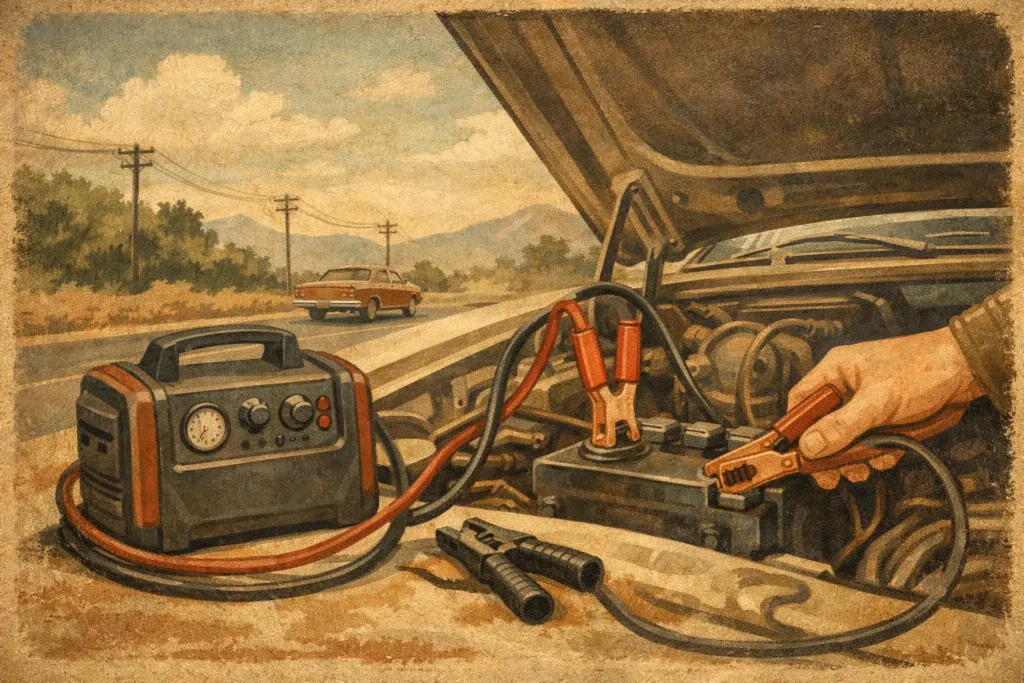
A flat battery rarely happens at a convenient time. You might be outside the house before work, parked at the supermarket, or stuck after leaving the interior light on overnight. A car battery booster review can help you choose a compact jump pack that gets you moving without waiting for another driver – but only if it is suitable for your vehicle and used correctly.
Battery boosters are useful emergency tools, not a cure for every non-start. If the battery is old, damaged or repeatedly going flat, a booster may start the car once while the underlying fault remains. Knowing the difference can save time, money and a second breakdown.
A car battery booster is a portable lithium battery with jump leads attached. It delivers a short burst of power to help start a vehicle with a discharged 12V battery. Most also include USB charging ports, a torch and sometimes an air compressor, but the jump-starting performance should be the priority.
Do not judge a booster by its small size alone. Modern packs can be surprisingly powerful, yet the figures on the box need some context. A 1.0-litre petrol hatchback generally needs far less starting power than a 3.0-litre diesel van. Cold weather, a weak vehicle battery and a stiff engine all increase the demand.
The most useful review looks beyond a headline peak-amp number. Peak current is the brief maximum a unit may produce under ideal conditions. It is not a guarantee that every 2,000A-labelled booster will start every engine. Look for clear guidance on the maximum petrol and diesel engine sizes, plus genuine customer feedback from owners of similar vehicles.
For many small and medium petrol cars, a well-made booster rated around 800A to 1,000A is usually sufficient. Larger petrol engines, diesels, vans and vehicles used for towing may need a higher-rated unit. Diesel engines usually require more cranking power, particularly on cold mornings.
Compatibility matters more than buying the biggest figure available. An oversized, expensive pack is not automatically better if it is awkward to store, difficult to charge or poor quality. Conversely, a cheap low-output booster can leave you stranded if it cannot cope with your engine when the temperature drops.
Check that the pack is designed for 12V vehicle batteries. Most cars on the road use 12V systems, but do not assume every vehicle does. Larger commercial vehicles may use 24V systems and need specialist equipment. Never try to use an ordinary 12V booster on a 24V vehicle.
The clamps are not an afterthought. They need strong springs, solid jaws and cables that feel substantial rather than thin and flimsy. Poor clamps can make weak contact with battery terminals, which reduces the chance of a successful start and can create excess heat.
A good booster should include reverse-polarity protection. This warns you, or prevents operation, if the red and black clamps are connected to the wrong terminals. Spark protection, short-circuit protection, over-current protection and over-temperature protection are also worthwhile. These features do not replace care, but they provide a useful safety margin when you are dealing with a stressful roadside problem.
Avoid packs that make vague claims about safety without explaining the protection built into the smart clamp lead. Clear instructions in proper English, a recognisable manufacturer, a warranty and accessible support are positive signs. If the listing is unclear about specifications or compatibility, treat that as a warning.
Capacity is commonly shown in milliamp hours, or mAh. It can indicate how much stored energy the pack has, but it is not the only measure of jump-starting ability. A large capacity figure does not tell you how effectively the unit can deliver high current to start an engine.
It does affect how many attempts you may get between charges and how useful the pack is for charging a mobile phone. A USB-C input can make recharging more convenient, while a battery level display is far better than relying on a row of vague indicator lights.
A built-in torch is genuinely useful when a battery fails at night. An SOS flashing mode may help in an emergency, although it should not be your main roadside safety plan. Air compressors and 12V accessory sockets can be handy, but they add bulk and give you more to maintain. Buy a booster first for starting a car, then consider extras only if you will use them.
A booster can help where the battery is simply discharged. Common examples include leaving lights on, short journeys gradually draining an already weak battery, or a car that has been parked for several weeks. Once started, the vehicle should be driven or checked properly rather than switched off again after a few minutes.
It may not help if the battery has an internal fault, the terminals are badly corroded, the alternator is not charging, the starter motor has failed or there is an electrical issue drawing power while the car is parked. You may hear a click, see dashboard lights flicker or get no response at all. Those signs need diagnosis, not repeated jump-start attempts.
Do not use a booster on a battery that is cracked, leaking, badly swollen, frozen or giving off a strong sulphur smell. Keep flames, cigarettes and sparks away from the battery area. If you are unsure about the condition of the battery, step back and arrange assistance.
Read the instructions supplied with your own model, as connection procedures can vary. In general, turn off the ignition and electrical loads, place the booster securely, then connect the red clamp to the positive battery terminal. Connect the black clamp as instructed by the manufacturer, normally to the negative terminal or a suitable earth point.
Make sure the clamps are not touching each other or loose metal parts. Switch on or activate the booster if required, then try to start the vehicle. Keep each attempt short. If it does not start after a couple of sensible attempts, stop rather than flattening the booster or overheating the cables.
Once the engine is running, remove the clamps in the reverse order recommended by the manufacturer and recharge the booster as soon as possible. Leaving a jump pack discharged in the boot for months is one of the most common reasons it fails when needed.
Before buying, match the booster to your engine size and fuel type, then check the quality of the clamps and the safety protections. Choose a unit that can be charged easily at home and stored safely in the vehicle. It should also be small enough that you will actually keep it with you.
Temperature ratings deserve attention in the UK. Lithium packs lose performance in very cold conditions, and a booster left in a freezing car may not perform as well as expected. Store it in a protective case, keep it dry and check its charge every few months. Do not leave it on a hot dashboard in summer.
For a family car, a straightforward model from a known supplier with clear 12V compatibility and reverse-polarity protection is often the sensible choice. For a diesel vehicle, van or work vehicle, spend more on suitable starting power and durable leads. The cheapest option is rarely good value if it works only in warm weather on a lightly discharged battery.
A booster is ideal when you are prepared and the issue is a simple flat battery. It is less helpful when you are on a busy road, do not know where the battery is located, have no safe place to work, or suspect a more serious fault. Repeatedly trying to start a vehicle can make a bad situation worse.
If you are in Peterborough or the surrounding area and need immediate help, Car Recovery Peterborough can provide a professional jump start and assess the immediate situation safely. If the car still will not start, recovery avoids the risk of being stranded again a few miles down the road.
Keep a charged booster as part of basic vehicle preparation, alongside a warning triangle where appropriate, warm clothing and a charged mobile phone. It is a small purchase that can solve a simple problem quickly – provided you choose it for your vehicle, maintain it and recognise when the car needs more than a boost.
Need recovery right now?
WhatsApp Us
Best car recovery response times depend on location, traffic and vehicle type. Learn what is realistic, what causes…
Read article
Need car towing Peterborough drivers can rely on? Fast 24/7 recovery, clear pricing, local coverage and same-day help…
Read article
Need roadside help PE2 drivers can rely on? Get fast 24/7 support for breakdowns, jump starts, flat batteries,…
Read article